


| Note - 1 | Sugarwell Farm | |
|
The ancient meaning of "Sugarwell" was a perpetual spring. Note: - Some authorities claim it to mean 'Perennial' A little way up Saddleback Lane (PP No.20) opposite Sugarwell Farm gate can be seen the spring which gave the farm its name
|
||
| Note - 2 | George & Dragon | |
|
The George & Dragon is well over 400 years old and is situated at the crossroads in the centre of the village. In days gone by a requirement of all Inns was that they should provide board and lodgings for a traveller and his horse, that the George and Dragon complied with this requirement is evidenced by the old painted sign just visible on the corner of the front wall advertising that they provided "GOOD STABLING".
| ||
| Note - 3 | Abbots Ball Farm | |
|
The name 'Abbots Ball' is probably derived from the fact that the Manor of Potterne was held by the Bishop of Salisbury and it is not unlikely that this area of land was allocated to the abbot for his keep or alternatively it may be that it was called after the 17th. century Bishop Abbot, whilst "Ball" means a small hill.
| ||
| Note - 4 | Barbones | |
|
Barbones field and Plantation is named after a John Barbon who's name appears in the 1571 Potterne parish register
| ||
| Note - 5 | Pound Hill | |
|
Pound Hill is one of the Five Lanes (PP No.108), it derives its name from the village pound which was situated at its junction with the Worton Road.
The village pounds were in the charge of the Hayward, an elected officer of the parish who was responsible for catching any straying livestock, 'impounding' and caring for them until their rightful owner laid claim to them when he would also be responsible for collecting the cost of their keep and any fine imposed for their straying.
| ||
| Note - 6 | Grubbe Family | |
|
The Grubbe family were one of the largest land owners in the district and are descended from a Danish family, the first of whom to settle in England was Thomas Le Grubbe who had a chateau at Dover in 1306.
A Robert Grubbe lived at Devizes where he died in 1499 and a Hr. Henry Grubbe was Mayor of Devizes in 1568 and Member of Parliament for Devizes in 1577. In 1721 manors, lands etc. 'in Devizes, Potterne, Potterne Wyke and other places' were conveyed by William Kent to William Grubbe and Francis Sadler Eastwell House, the long time home of the Hunt-Grubb family is early 16th century, but was almost completely rebuilt in 1772.
| ||
| Note - 7 | Saddleback Lane | |
|
This bridleway was once known as Packsaddle Lane having been used by pack ponies in days gone by,
| ||
| Note - 8 | Green Lane | |
|
Curiously missing from the book!
| ||
| Note - 9 | Nine Hills & Limers Lane | |
|
Nine Hills or to give them their old name "Lime Hills" were created by the "Limer's" excavating lime and transporting it by pack horses for sale around the countryside probably for use as building material.
Limers Lane (PP No.47) leads from the old lime hills to the main Devizes road (A360) and was used by the limers ponies for transporting the lime, hence its name.
| ||
| Note - 10 | Potterne Mills. | |
|
Potterne is recorded in the Doomsday book as having six mills.
i. Drews Ponds, (there are three of them) were originally constructed to hold the water for working one of the six Potterne mills recorded in the Doomsday Book, now they are managed as a private wildfowl reserve.
| ||
| Note - 11 | The Church of St. Mary the Virgin. | |
|
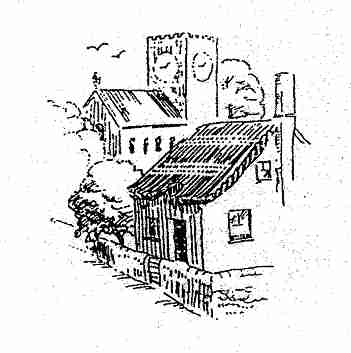
The church of St. Mary The Virgin was built in the middle of the 13th century, there has been little change to the original structure apart from the addition of a South porch in the 14th century and the raising of the tower in the 15th. The font, dating from the early 15th century is not the original, an earlier 10th century font having bean found beneath the nave floor in 1812 whilst there is evidence of an earlier Saxon church at the rear of Porch House.
| ||
| Note - 12 | Porch House. | |
|
This is a nationally famous timbered dwelling situated in the centre of the village. Built in the 15th century it as, during its long life been many things including a domestic residence, a brewery, a bakehouse, a barracks and an Inn, the 'The White Horse', today it is again a private dwelling.
| ||
| Note - 13 | Potterne Field. | |
|
This was probably once part of the open field system of farming in use from the middle ages whereby all the villagers shared the fields in common.
| ||
| Note - 14 | Potterne Little Tree. | |
|
At the top of Potterne field and a little to the right of the path is Potterne Little Tree', the original tree, an elm was planted by General Hunt-Grubbe to commemorate the Battle of Waterloo, it is from this tree that the hill has acquired the name of One Tree Hill, the tree was originally surrounded by railings, but there is no sign of these today.
The present tree is a young oak which was planted to replace the original elm tree struck by lightening a few years ago, the burnt remains of this tree can still be seen on the ground close by the young oak. There is no right of way across the few yards to this tree and so one must be content with viewing from the path.
| ||
| Note - 15 | Barbones. | |
|
Barbones field and Barbones plantation is so called after a John Barbon who's name appears in the 1571 Potterne parish register.
| ||
| Note - 16 | Blounts Court. | |
|
The manor of Blount's Court came into being when in 1270 Geoffrey le Blunt of Potterne was granted exception for life from various offices, later in 1426 these lands were referred to as 'a manor in the vill of Potterne' the manor being sold in 1643 by William Frampton, the present house was built by William Stancomb in 1809. Since the last war the house has been turned into flats and the adjacent land used for the development of Blounts Court housing estate, The Stancomb families connection with Potterne is maintained in the ownership of several farms in the district which once formed part of a great estate.
| ||
| Note - 17 | Potterne Wick. | |
|
A Wyke, which we now spell 'Wick' was a collection of cottages and buildings being a part of, but separated from the main village, as is still the case today with Potterne Wick.
| ||
| Note - 18 | Devizes Castle. | |
|
It is thought that Devizes could be of Roman origin, however we do know that in 1080 Bishop Osmand, a nephew of William the Conqueror built a wooden castle at this point on a tongue of land conveniently flanked by two ravines and that it was behind this early structure that the town we know to day grew up. It may be coincidence or it may have been by design that the neighbouring parishes of Rowde, All Cannings and Potterne met at the approximate centre of the county of Wiltshire, and that it was here at this meeting of parishes that the good Bishop built his castle around which the town developed.
A town at the meeting of parishes, a town at the division of the county, a division that was to give the town its name "Ad Divisa" which translated from the Latin means "at the boundaries", it is not difficult to see that over the years this has changed from the Latin to its present name of Devizes. In 1089 when the Doomsday book was compiled Devizes must have been of no significance as it - as not thought worthy of inclusion, All Cannings being looked on at that time as the most important place in this part of Wiltshire. Henry 1 appointed his Chancellor Roger of Caen, a man of Norman birth to be Bishop of Salisbury and in 1102 Roger started to replace the original wooden cots construction erected by Bishop Osmond with a castle "of exceptional magnitude". After the disgrace of Roger in 1139 the castle was seized by King Stephen and in the 14th century formed part of the Queens dowry. The present castle is of a still later date.
| ||
| Note - 19 | Five Lanes Junction | |
|
These are the ancient thoroughfares upon which local agriculture depended for the transportation of livestock and farm produce, these lanes have for centuries been notoriously muddy giving rise to the footpaths in neighbouring fields which were used by the cottagers when going about their business so as not to get their feet to wet and muddy giving us a legacy of paths to walk and enjoy in this area.
Working in a clockwise direction, the Five Lanes are:-
|
© 1993 Leslie. J. Turner


